
LVDT position sensors meet the demanding requirements of steam turbine applications
Sep 06, 2024
Control valve performance is critical to improving gas turbine efficiency. Since the valves regulate the flow of fuel in the different components of the gas turbine, the precise monitoring and control of the flow of these valves allows the turbine to operate more efficiently while minimizing energy waste.
Gas turbines utilize a variety of valves—including control valves, inlet guide vanes, transfer valves, gate valves, and bleed valves—each serving a distinct function. For instance, a bleed valve is designed to release a small amount of fuel or air, whereas a gate valve is primarily used to fully allow or block gas flow, not for regulation. The correct opening and closing of these valves are governed by the plant's specific control scheme.

As a rule, gas turbine power plants operate under highly accurate control algorithms. Therefore, valve positions need to be monitored at all times to ensure proper operation. While many valve users may only need to know whether a valve is open or closed, some control systems require precise valve positioning. For example, since a bleed valve functions as a regulating valve, it should be adjusted to a specified position based on the power generated. By ensuring that valves are properly opened or closed to the correct position, power plants can operate more efficiently.
While the actuator drives the valve, the feedback device conveys the valve's position data back to the turbine control system, indicating whether and to what extent the valve should open or close. LVDTs (Linear Variable Differential Transformers) are commonly used as position feedback sensors, providing precise valve position measurements to ensure stable turbine operation. Constructed from stainless steel and certified for intrinsic safety and explosion-proof operation, these sensors are designed to perform reliably in high-temperature, harsh, and potentially explosive environments. They convert the linear displacement of a mechanically coupled component into a corresponding electrical signal, which the controller uses as a critical input within the overall control system.
This picture is forbidden to reprint, please indicate the name or website of the company for reprinting.
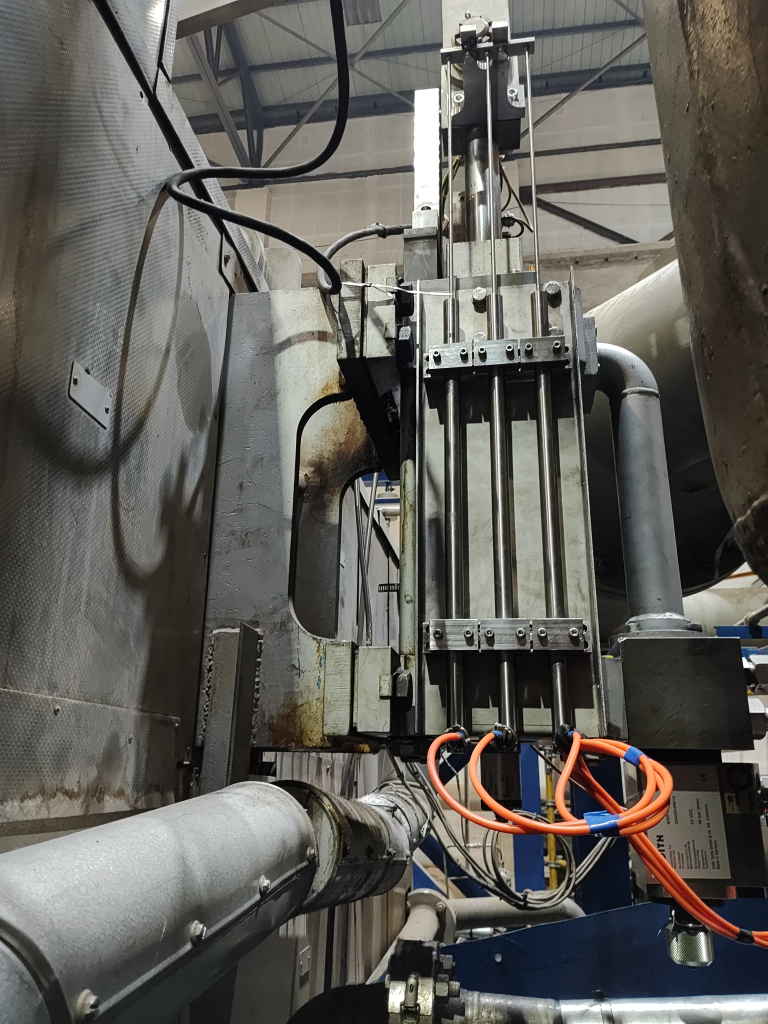
LVDT position sensors are double or triple redundant mounted on the actuator of a moving gate or rotary ball/butterfly valve, and the sensor "tells" the turbine control system where the valve is "open" or "closed" and at what rate. Using LVDT position feedback, the control system determines whether more or less fuel is needed for the turbine to function properly and signals the actuator to move the gate, or ball/butterfly valve to make necessary valve adjustments. When the actuator starts moving the valve, the sensor sends an analog electrical signal to the control system that is proportional to the valve opening. By providing LVDT sensor feedback in real-time, the actuator can be continuously adjusted until the desired opening is reached.
LVDT position sensors withstand significant shock and vibration, and perform reliably even when exposed to extremely harsh environments.
A key reason for the reliable performance of LVDT sensors in power plant systems lies in their separated design: the sensitive electronics (signal conditioner/transmitter) are housed remotely, while only the robust sensor is mounted directly on the turbine. This configuration allows the LVDT to endure intense heat of 150°C to 200°C at the turbine while the electronics operate safely under ambient conditions.
ABEK SENSORS' SCAC06 series LVDT signal conditioners can match most LVDT sensors on the market, regardless of the position of 3-wire, 4-wire, 5-wire, 6-wire and LVDT core, the maximum and minimum position can be calibrated according to the valve position opening corresponding to the output analog signal.
Due to the presence of gaseous vapors in gas turbines, LVDTs installed on turbines must meet safety parameters and be approved by explosion-proof certification bodies. These requirements set the standard for sensor designs based on an "ignition curve" environment. The inductance of the LVDT sensor is designed below the ignition curve and there is never enough power to ignite any gaseous vapors present in standard operation or fault conditions.
LVDT technology uses the transformer principle to measure linear displacements in gas turbines. The primary coil is excited by an AC signal. The core is AC coupled to two secondary coils that are wound 180° out of phase. If the position of the core is coupled with a greater voltage on one secondary than the other, the output increases linearly proportional to the amount of core displacement.
About ABEK SENSORS
ABEK sensors designs position measurement solutions for a wide range of challenging applications in harsh environments. This includes the supply of radiation-resistant, ultra-high temperature valve position sensors for valves for nuclear applications (pilot-operated safety valves, regulator spray valves). LVDT sensors can be used alone or as part of an assembly. Abek sensors can design LVDT sensor interfaces according to customer installation structure requirements, and can provide position measurement system solutions from LVDT position sensors, signal conditioners, signal acquisition and processing equipment, etc.
ABEK SENSORS designs and manufactures position sensors for harsh environments. If you have any difficult position measurement questions, please contact us!
Fill out the form and our technical engineer will contact you. Or you can reach out us via tel 400-013-6886 or email info@abeksensors.com.