
LVDT Position Sensor Tutorial
How LVDT works
What is LVDT?
LVDT is the abbreviation of Linear Variable Differential Transformer, which is a type of electromechanical sensor. LVDTs convert the mechanical variation of linear motion into corresponding electrical signals. LVDT linear position sensors can measure displacements as small as 0.1mm and can also measure displacements as far as 1000mm.
For over 50 years, LVDT linear displacement sensors have been a reliable linear position feedback tool in various laboratory, industrial, military, and aerospace applications. LVDTs are devices with inherent reliability, capable of providing high-precision linear displacement measurements ranging from 0.1mm to 1000mm, and they are suitable for a wide operating temperature range.
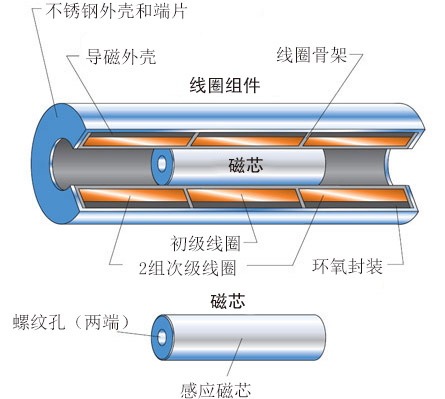
The components of a typical LVDT position sensor are shown in Figure 1. The internal structure of the sensor includes a primary coil and two secondary coils. These coils are wound around a hollow high-strength framework, and to ensure moisture resistance, they are further wrapped with a layer of highly permeable insulation material, which is then sealed within a cylindrical stainless-steel tube. This coil assembly is generally an essential component of position sensors.
The LVDT mover assembly is a magnetically permeable cylindrical core that can move freely in a hollow coil and be connected to the object to be measured. The inner hole of the coil is larger than the outer diameter of the core, providing an effective gap, so that there is no friction or contact between the core and the coil.
When operating, a certain frequency of alternating current is applied to the primary coil, which is known as primary excitation. The output signal of the LVDT is the AC voltage difference between the two sets of secondary coils, which changes with the position of the core in the coil. Usually, for the convenience of users, the AC output signal of the LVDT is demodulated by the electronic circuit and converted into DC voltage or current output.
How LVDT works
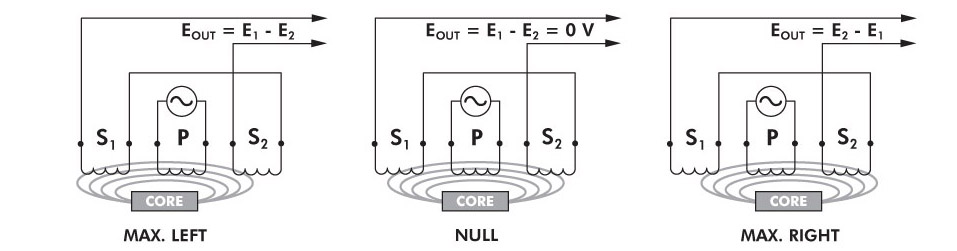
Figure 2: The core in different positions
Figure 2: What happens when the core is in different positions? When the primary coil (P) of LVDT is excited by an AC power supply of 2.5KHz~10KHz, the generated magnetic flux is coupled to the adjacent secondary coils S1 and S2 through the core. If the core is located halfway between S1 and S2, the same magnetic flux is coupled to the secondary side. Therefore, the voltages E1 and E2 induced in each coil will also be equal. So, when the core is at the center point, which is the so-called origin, the voltage difference (E1 -E2) of the output should be equal to zero.
When the core moves away from the center of the LVDT, called the null point, the signal from the primary will be coupled to one secondary more than the other secondary. As the core moves across S1, the voltage output of S1 increases. As the core moves on S2, the output of S2 increases. The values of (S1 – S2) and (S2 – S1) become linear functions of the core position as they move towards S1 and S2, respectively.
A typical output of an AC LVDT is shown in Figure 3. When the core moves away from the null point in either direction within the LVDT range, the voltage output (S1 – S2) and (S2 – S1) increase proportionally.
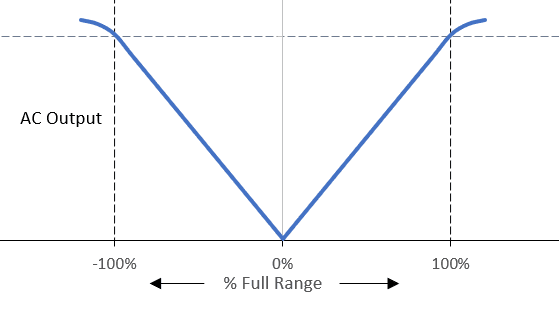
Figure 3: Typical output of an AC LVDT
DC LVDT
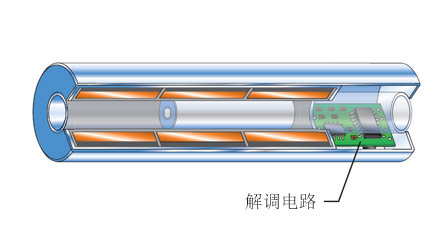
A DC LVDT integrates signal conditioning electronics in the sensor, allowing users to supply a DC input and measure a DC output proportional to core position. DC LVDTs retain all the advantages of traditional LVDT technology while offering the convenience of DC excitation and output signals.
Because DC LVDTs contain electronics within the sensor body, DC LVDTs are subject to temperature constraints due to the material properties of the electronic components in the electronic signal conditioning module, typically using a temperature range of -20°C to 80°C.
ABEK SENSORS designs and manufactures position sensors for harsh environments. If you have any difficult position measurement questions, please contact us!
Fill out the form and our technical engineer will contact you. Or you can reach out us via tel 400-013-6886 or email info@abeksensors.com.