
Effect of Temperature Changes on LVDT Position Sensors
Jul 27, 2024
For over 50 years, LVDT linear displacement transducers have been a reliable linear position feedback tool in a variety of laboratory, industrial, military and aerospace applications. LVDT displacement transducers are inherently reliable devices that provide highly accurate linear displacement measurements from 0.1mm to 600mm and are suitable for a wide range of operating temperatures. While the output stability of LVDT linear displacement transducers is suitable for many applications, it can be affected by temperature variations. In specific applications, such as in aircraft, subsea equipment and turbomachinery, temperature effects can be significant.
Effect of temperature change on the output signal
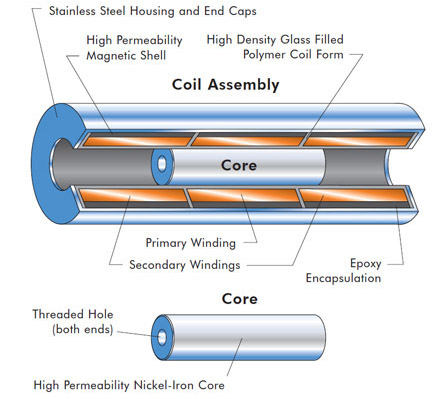
Temperature changes can affect the output signal of the LVDT in two different ways, including mechanical expansion and changes in the electrical properties of the LVDT. Mechanical expansion causes relative motion between the LVDT core and the LVDT windings.
Temperature changes can affect the output signal of the LVDT in two different ways, including mechanical expansion and changes in the electrical properties of the LVDT. Mechanical expansion causes relative motion between the LVDT core and the LVDT windings.
The ultimate effect is to signal spurious core motion and produce a null-migration error. Temperature may also affect the electrical properties of the LVDT by changing the primary input current of the LVDT or the magnetic properties of the core material. This can produce a scale factor change or a travel migration error.
AC LVDT
Because AC LVDT sensors can have an external signal conditioner, AC LVDT position sensors can operate at a maximum temperature of up to 500°C.
DC LVDT
Because DC LVDTs contain electronics within the sensor body, DC LVDTs are subject to the temperature limitations of the material properties in the electronic signal conditioning module and are typically used in temperatures ranging from -20°C to 80°C.
DC LVDT position sensors can operate at temperatures down to -40°C if the temperature is close to constant.
environmental temperature
Ambient temperature variations have a predictable effect on the operation of AC-powered and DC-powered LVDTs. While a signal conditioner can help compensate for variations in the primary current of AC LVDTs, DC LVDTs are unable to use this method due to space constraints.
Effect of temperature on materials
Temperature variations have very little effect on the magnetic properties of the LVDT core material and have a negligible effect on the LVDT over the normal operating temperature range. To offset the effect of the coefficient of thermal expansion of the LVDT material, the LVDT is designed with an output structure in which the output coils are symmetrically distributed from the center to the ends.
New manufacturing techniques and materials also enable LVDTs to operate in harsh environments, including extreme high and low temperatures.
ABEK SENSORS can design customized LVDTs for continuous operation in environments as high as 500°C and as low as -200°C. The LVDTs are available in a wide range of sizes and sizes.
Temperature-induced resistance changes
Elevated LVDT coil temperatures increase the resistance of the copper wire commonly used in the primary and secondary coils. The most immediate consequence of this increased resistance is an increase in primary impedance.
Primary Current Stability
A constant current excitation source is an obvious but not always practical solution to the effects of temperature. If a constant current supply is not available, some stabilization of the primary current can be achieved by placing a large external resistor in series with the primary.
Contact us
Do you have any questions or need a quotation? We are always ready to offer help!
Fill out the form and a member of our sales team will contact you to discuss your requirements. You can also call +86 18614278800