
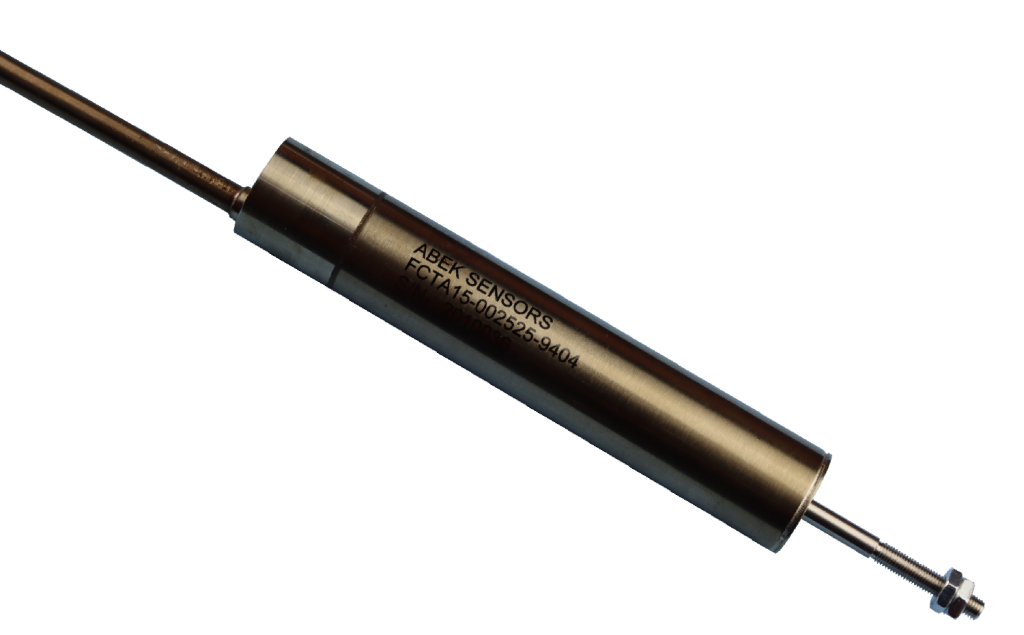
ATX-XR Series
High-Temperature & High-Radiation Hardened LVDT for Extreme Environments
Features
- Resistant to gamma and neutron radiation
- Resistant to extremely high and low temperatures
- 100% inorganic material
- Range: ±5mm to ±25mm
- Operating temperature: -200°C to +550°C
- Working pressure: 20 MPa
- Linearity: ±0.5% or ±1%
- Calibration service at specified temperatures
- Signal or dual wire options
- Threaded or flanged connections
Applications
- Deformation of components inside the reactor
- Reactor Valve Position Feedback
- Nuclear-grade flowmeter
- High-temperature and high-pressure reactor
- Engine Thrust Vectoring Feedback
- Cryogenic superconductor (physics)
- Applications in harsh environments
Radiation Basics
Certain applications require materials to be resistant to gamma radiation and neutron radiation, as well as capable of withstanding high temperatures. Before examining specific technical specifications and suitability for particular applications, it is necessary to first clarify the following working definitions and equivalence relationships.
Total integral neutron flux
- Neutron flux: the total distance traveled by all neutrons per unit time and per unit volume
- Formula for calculating neutron flux:
Number of neutrons / Volume × Distance / Time = Neutron density × Neutron velocity
- Neutron density: the number of neutrons (n) per unit volume
- Formula for calculating the total neutron flux:
Neutron density × velocity × time = neutron density × distance
- Total neutron flux in units of:n/m³×m = n/m² (n: number of neutrons; m: meters) or use NVT (n/cm²)
- Unit conversion: 1 NVT = 10⁴ n/m²
Total Integrated Dose (TID) of Gamma Rays
- Rad (radiation absorption dose): The amount of radiation that deposits 0.01 joules of energy per kilogram of material
- Gy: The amount of radiation that deposits 1 joule of energy per kilogram of matter (international standard unit)
- Unit conversion: 1 Gy = 100 rad
When radiation energy strikes an object, even if the energy levels of different radiation sources are equal, the extent of damage caused can vary significantly depending on the type of radiation (such as gamma rays or neutrons), and the mechanisms of damage may also differ fundamentally.
There are two methods for quantifying such differences:
- Determine the radiation flux density that the device can withstand without sustaining transient irreversible damage;
- Determine the total integrated flux that a device can absorb before it sustains damage due to radiation-induced “ageing failure.”
Electrical Specifications
| Parameters | Description |
| Input Voltage: | 1 to 12V AC, 3V rms |
| Input Frequency: | 400 to 10k Hz, 2.5 kHz(rms) |
| Linearity Error: | <±0.5% or 1% FSO |
| Repeatability Error: | <0.01% (Full stroke) |
| Hysteresis Error: | <0.01%(Full strokel) |
Environmental Constraints
| Parameters | Description |
| Operating Temperature | -200°C to +550°C |
| Storage temperature: | -240°C to +600°C |
| Radiation resistance: | Total neutron flux: 3×10²⁴ n/m² |
| Radiation resistance: | Total cumulative gamma-ray dose: 10⁹ Gy |
| Working Pressure: | 20MPa |
| Impact resistance: | 10 G, (11 ms half-sine wave) |
| Vibration: | 10g, 2kHz |
| Housing Material: | SUS304 |
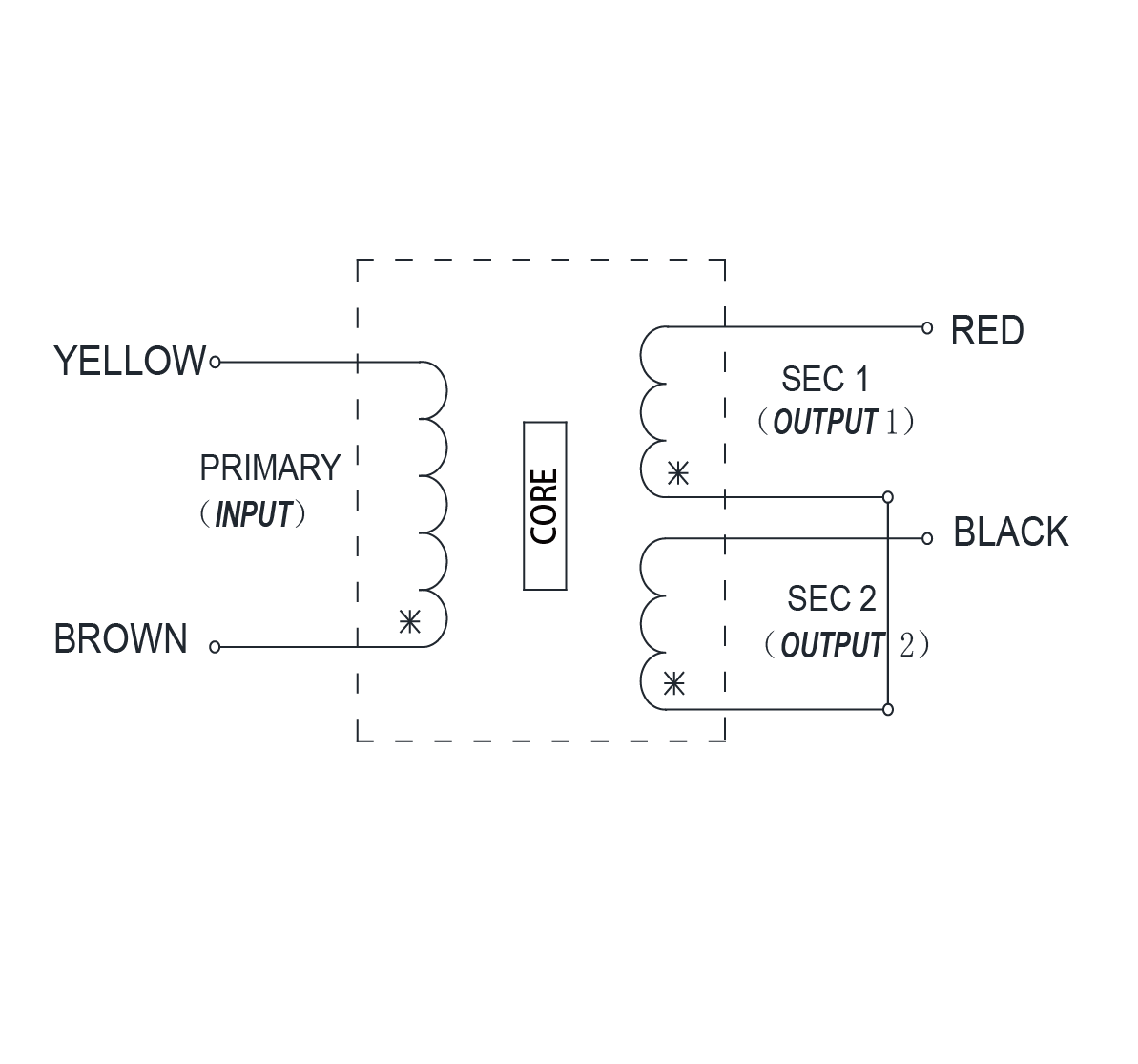
Wiring Connection
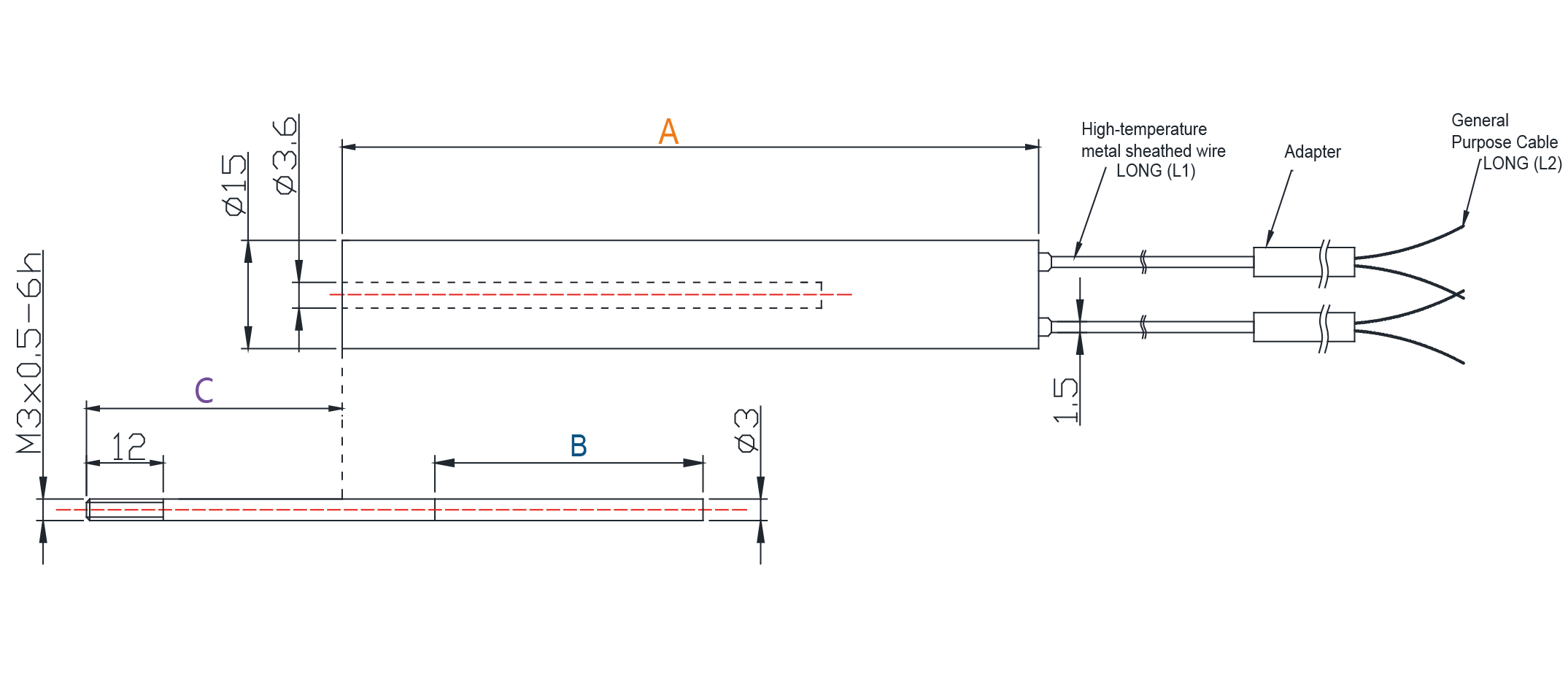
Dimensions
Double 2-core cables
Single metal cable O.D. 1.5mm.
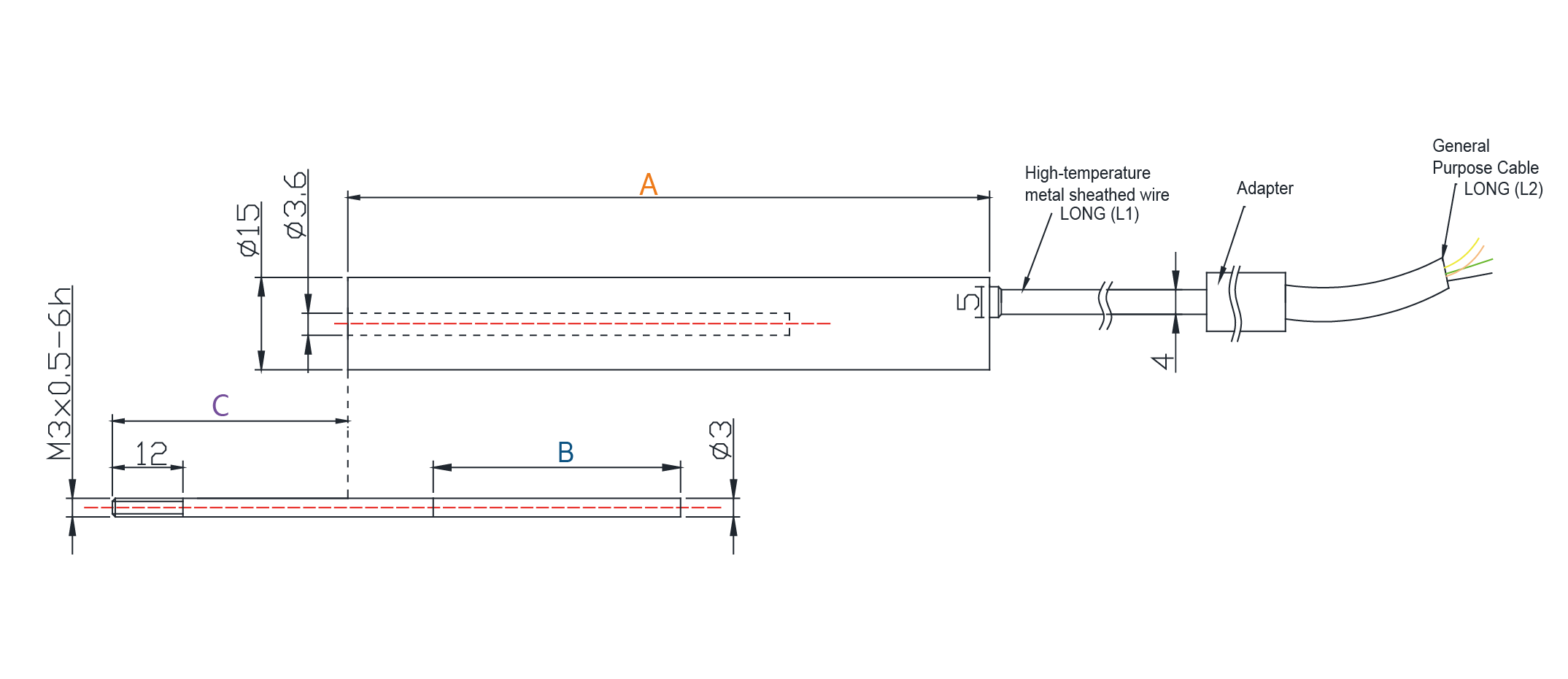
Single 4-core cable
Metal cable O.D. 4mm
| Parameters | Range | Body length “A” | Core length "B" | Null Position “C” | Sensitivity | |
| Range code | mm | mm | mm | mm | mV/V/mm | |
| 010 | ±5 | 0-10 | 109 | 42 | 30 | 30 |
| 030 | ±15 | 0-30 | 133 | 50 | 50 | 16 |
| 050 | ±25 | 0-50 | 192 | 76.2 | 80 | 14 |
Specialized Accessories
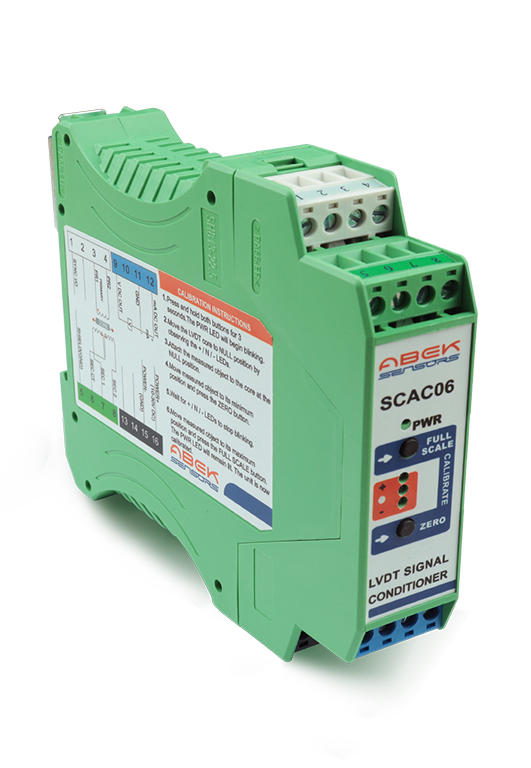
LVDT/RVDT Signal Conditioner
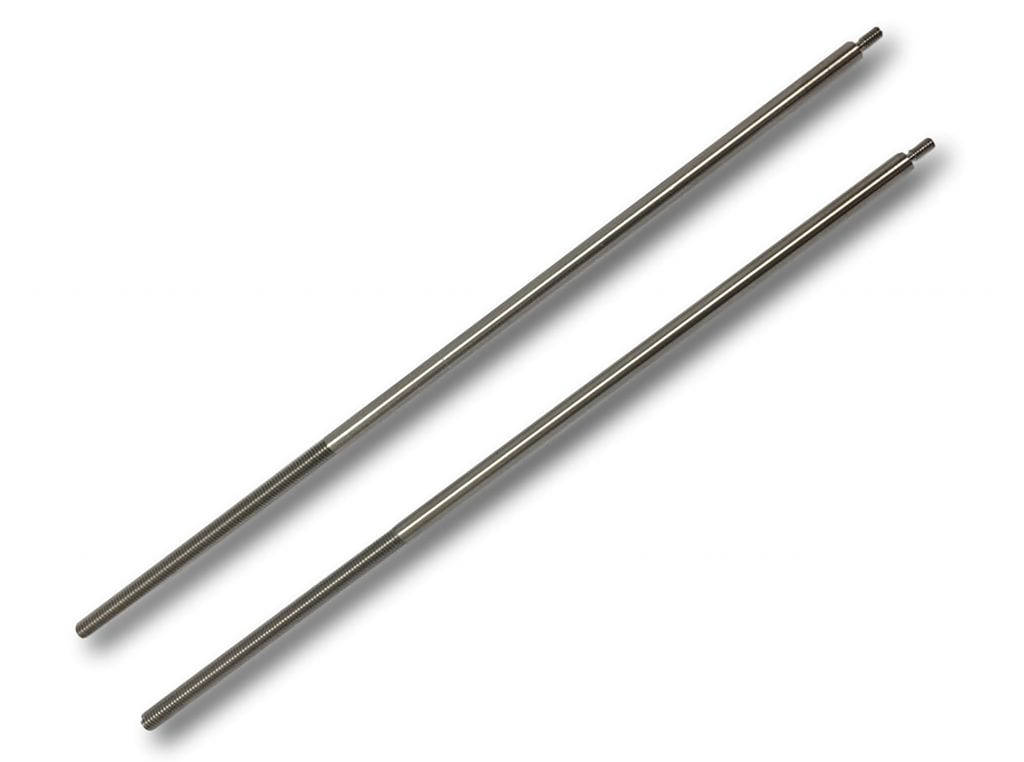
Extension Rod
 简体中文
简体中文  English
  العربية
  Français
  Deutsch
  한국어
한국어  Русский
  Español
  Türkçe